- 0
- 1.977 word
Simple, consistent stretching routines can reduce pain, improve posture, and help you stay active well into your 60s and beyond — here’s what the evidence says and how to get started today.
Carol, 48, had spent years dismissing the stiffness she felt every morning as just "getting older." Getting out of bed felt like a slow negotiation with her own body. Bending down to tie her shoes had become something she dreaded. Then her physical therapist suggested something surprisingly simple: a 10-minute daily stretching routine. Within six weeks, Carol noticed she was moving more freely, sleeping better, and even standing taller at her desk.
Carol’s experience is far from unique. According to the American College of Sports Medicine, flexibility naturally declines by roughly 50% between the ages of 30 and 70 — and most adults do almost nothing to slow that process. The result is a cascade of issues: joint pain, poor posture, reduced balance, and a higher risk of injury during even everyday activities like reaching overhead or stepping off a curb.
In this guide, you’ll learn what flexibility actually means, why it matters so much after 35, what the research says about effective stretching, and how to build a practical routine that fits your life — no gym membership required.
What Is Flexibility — and Why Does It Decline After 35?
Flexibility refers to the ability of your joints and muscles to move through their full range of motion. It’s not just about being able to touch your toes. It affects how you sit, stand, walk, lift objects, and recover from physical activity.
Your flexibility is largely determined by the health of your muscles, tendons, ligaments, and the connective tissue surrounding your joints — collectively known as the musculoskeletal system. When these tissues are supple and well-hydrated, movement feels smooth and effortless. When they become tight or shortened, you feel stiff, restricted, and sometimes in pain.
After age 35, several biological changes accelerate this stiffening process:
- Collagen changes: Collagen fibers in tendons and ligaments become less organized and more crosslinked with age, reducing their elasticity.
- Reduced muscle water content: Muscles lose water as you age, making them less pliable.
- Decreased synovial fluid: The lubricating fluid inside your joints becomes less abundant, increasing friction and stiffness.
- Sedentary habits: Long hours sitting — at desks, in cars, on couches — shorten hip flexors, tighten hamstrings, and compress the spine.
According to Johns Hopkins Medicine, decreased flexibility is one of the primary contributors to lower back pain, which affects roughly 80% of Americans at some point in their lives. The good news: research consistently shows that regular stretching can meaningfully reverse age-related flexibility loss, regardless of when you start.
The Real-World Benefits of a Regular Stretching Routine
Many adults think of stretching as optional — a nice-to-do after exercise rather than a health priority. But the evidence tells a different story.
A study published in the Journal of Physical Therapy Science found that adults who performed static stretching four days per week for four weeks significantly improved their range of motion and reported lower levels of musculoskeletal pain. Here’s what consistent flexibility work can do for you:
- Reduces chronic pain: Stretching tight hip flexors, hamstrings, and thoracic muscles is one of the most effective non-pharmacological strategies for managing low back pain, according to clinical guidance from the Mayo Clinic.
- Improves posture: Tight chest and shoulder muscles pull your body forward into a hunched position. Stretching these areas helps realign your spine and reduce neck strain.
- Lowers injury risk: Flexible muscles and tendons absorb impact better, reducing the likelihood of strains, sprains, and tears — especially during activities like hiking, golf, or gardening.
- Enhances circulation: Gentle stretching increases blood flow to muscles, which supports tissue repair and reduces post-activity soreness.
- Supports mental well-being: Harvard Health Publishing notes that slow, intentional stretching activates the parasympathetic nervous system — your body’s "rest and digest" mode — helping to reduce cortisol and ease anxiety.
- Boosts balance and coordination: Improved hip and ankle mobility is directly linked to better balance, which becomes increasingly critical after 40 to prevent falls.
It’s worth noting that flexibility alone won’t solve all musculoskeletal issues. For best results, most physical therapists recommend pairing stretching with strength training — which helps stabilize the joints you’re opening up. You can explore more about strength training after 40 and how it complements flexibility work.
Types of Stretching: Which One Is Right for You?
Not all stretching is the same, and choosing the right type for the right moment matters — especially as you get older.
Static stretching involves holding a position for 15–60 seconds. It’s the most researched form and is best performed after exercise or as a standalone routine when muscles are already warm. Research from the National Institutes of Health suggests holding each stretch for at least 30 seconds produces greater flexibility gains than shorter holds.
Dynamic stretching uses controlled, flowing movements — leg swings, arm circles, hip rotations — to gradually increase range of motion. It’s ideal as a warm-up before physical activity because it raises muscle temperature without reducing power output.
Proprioceptive Neuromuscular Facilitation (PNF) involves alternating contraction and relaxation of a muscle while stretching it. PNF is highly effective but typically requires a partner or physical therapist. Studies indicate it produces the greatest short-term flexibility gains of any method.
Yoga and Pilates-based stretching combine flexibility with balance, breathing, and core activation. According to the Cleveland Clinic, yoga practiced two to three times per week has been shown to reduce lower back pain and improve functional mobility in adults over 40.
For most adults over 35 working independently, a combination of dynamic warm-up movements followed by static stretching is the most practical, evidence-supported approach.
A Practical Stretching Routine for Adults Over 35
You don’t need an hour-long class or a yoga studio membership to see real results. Research suggests that even 10 minutes of daily stretching — done consistently — produces measurable improvements in flexibility and pain levels within four to eight weeks.
Here’s a beginner-friendly daily routine targeting the most commonly tight areas in adults over 35:
1. Hip Flexor Stretch (Kneeling Lunge)
Kneel on one knee, push your hips gently forward, and hold for 30–45 seconds per side. Tight hip flexors are a primary driver of lower back pain in people who sit for long periods.
2. Hamstring Stretch (Seated or Standing)
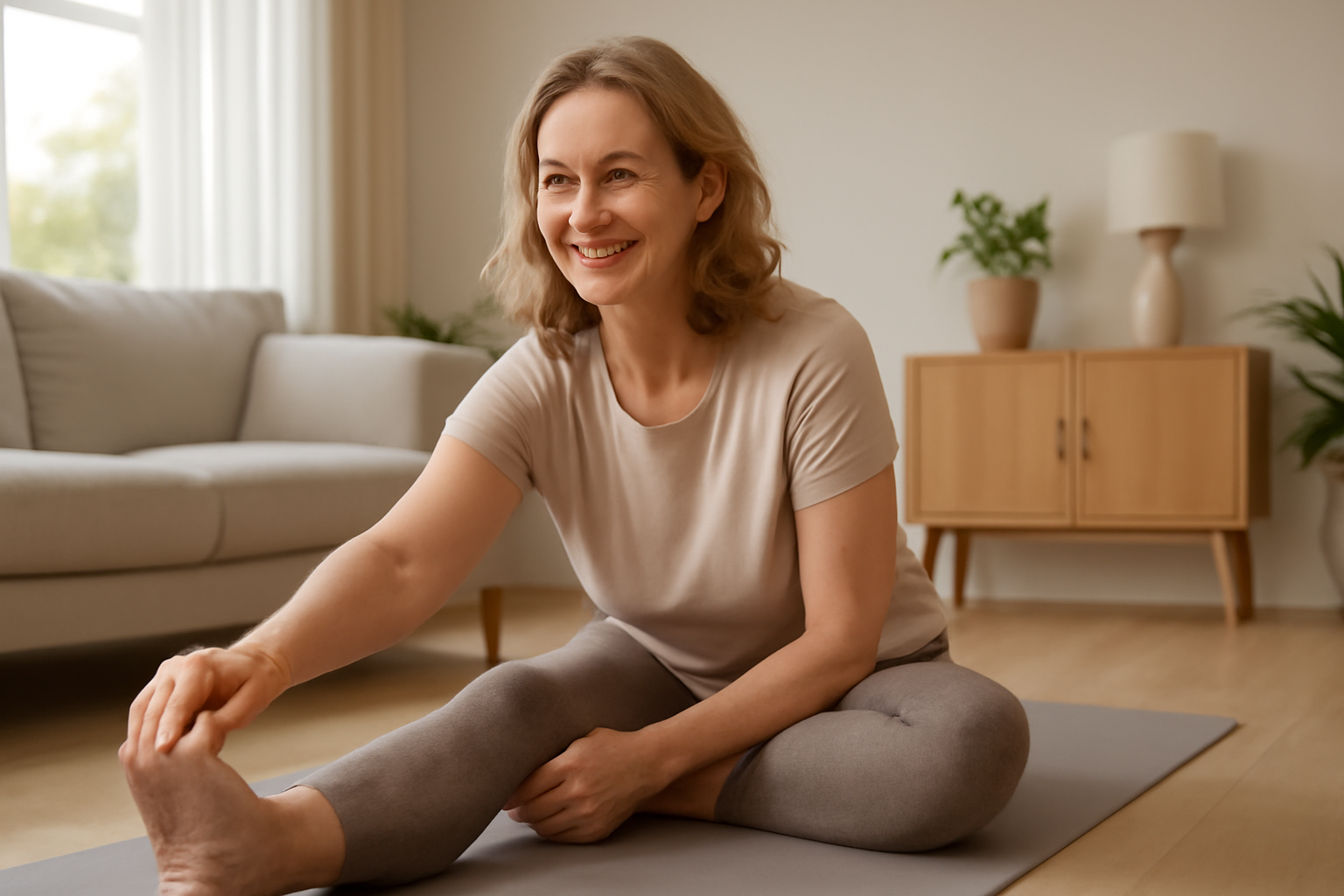
Sit on the floor with one leg extended and reach gently toward your foot, or stand and place your foot on a low surface. Hold for 30 seconds each side. The American College of Sports Medicine recommends this as a foundational move for adults with lower back discomfort.
3. Chest Opener (Doorway Stretch)
Place both forearms on either side of a doorframe and gently lean through the opening. Hold for 20–30 seconds. This counteracts the rounded-shoulder posture from extended screen time.
4. Cat-Cow Spinal Mobilization
On hands and knees, slowly arch and round your back 8–10 times. This gentle movement lubricates the vertebral joints and improves thoracic mobility.
5. Calf Stretch (Wall Stretch)
Place both hands on a wall, step one foot back, and press the heel into the floor. Hold 30 seconds per side. Tight calves contribute to ankle stiffness, knee strain, and poor balance.
6. Seated Figure-Four Stretch (Piriformis)
Sitting in a chair, cross one ankle over the opposite knee and gently press the raised knee downward. Hold 30–45 seconds. This targets the deep hip rotators, which are often tight in runners, cyclists, and desk workers.
Key safety reminders: stretch to a point of mild tension, never sharp pain. Breathe slowly and steadily throughout. If you have an existing injury or joint replacement, consult your doctor or physical therapist before starting any new routine. You may also find it helpful to pair your stretching practice with daily walking, which naturally warms up your muscles and supports joint health.
When to See a Doctor or Physical Therapist
Stretching is generally safe for most adults, but there are situations where professional evaluation is important before — or instead of — going it alone.
See a doctor or physical therapist if you experience:
- Sharp, shooting, or radiating pain during or after stretching
- Pain that worsens over time rather than improving with gentle movement
- Numbness or tingling in your arms, hands, legs, or feet
- Sudden loss of range of motion in a joint
- Swelling, warmth, or redness around a joint
- Stiffness that is significantly worse in the morning and lasts more than 45 minutes (this can be a sign of inflammatory arthritis)
When you see your provider, be specific: tell them which movements cause discomfort, how long you’ve noticed the stiffness, and whether it affects your daily activities. Ask about a referral to a physical therapist, who can assess your movement patterns and design a stretching protocol tailored to your body.
You may also want to ask your doctor about screening for conditions like osteoarthritis, hypermobility disorders, or inflammatory joint disease — all of which require modified approaches to stretching. Managing conditions like metabolic syndrome can also affect joint health and inflammation levels, so it’s worth reviewing what metabolic syndrome means for your body as part of a broader wellness picture.
Frequently Asked Questions
How long does it take to improve flexibility?
Most research suggests you can see measurable improvements in range of motion within four to eight weeks of consistent daily stretching. Individual results vary based on age, baseline flexibility, and which muscle groups you target. The key is consistency — short daily sessions outperform infrequent longer ones.
Is it okay to stretch every day?
Yes — for most adults, gentle static or dynamic stretching can be done daily without risk. Unlike heavy strength training, stretching does not require rest days to recover. According to the American College of Sports Medicine, stretching major muscle groups at least two to three days per week is recommended, but daily practice is both safe and beneficial.
Should I stretch before or after exercise?
Current evidence recommends dynamic stretching (moving warm-ups) before exercise and static stretching after. Performing prolonged static stretches on cold muscles before a workout may temporarily reduce muscle strength and power, according to research cited by the National Institutes of Health.
Does stretching reduce inflammation?
Research suggests that regular stretching may have modest anti-inflammatory effects by improving circulation and reducing mechanical stress on joints. However, if you have a condition driven by chronic inflammation — such as rheumatoid arthritis — stretching should be one part of a broader treatment plan supervised by your physician.
Can stretching help with lower back pain?
For many adults, yes. The Mayo Clinic notes that stretching the hip flexors, hamstrings, and piriformis muscles — combined with core strengthening — is among the most effective conservative approaches to managing non-specific lower back pain. That said, always rule out structural issues with your doctor before relying solely on stretching.
The Bottom Line
Flexibility isn’t a gift reserved for yogis and dancers — it’s a trainable, maintainable physical quality that pays enormous dividends as you age. Ten to fifteen minutes a day spent stretching your tightest muscles can translate into less pain, better posture, lower injury risk, and a body that feels genuinely capable rather than constantly constrained.
You don’t have to be perfect. You don’t have to be flexible already. You just have to start, be consistent, and listen to your body along the way. The adults who move well into their 60s and 70s aren’t lucky — they’re intentional.
As always, your own body is unique. Before beginning any new exercise routine, talk with your healthcare provider — especially if you have existing joint conditions, recent injuries, or chronic pain. A personalized approach will always serve you better than a one-size-fits-all solution.
Medical Disclaimer: This article is for informational and educational purposes only and does not constitute medical advice, diagnosis, or treatment. Always consult a qualified healthcare professional before making any health-related decisions or changing your treatment plan.
Reviewed by the Healthy Care Today Editorial Team — a group of health writers committed to evidence-based wellness content for everyday Americans.
Autor

negociosnanet001@gmail.com
Posts relacionados

Healthy Morning Routines That Transform Your Day After 40
- 0
- 2.291 words
Small morning habits can have a powerful ripple effect on your energy, mood, and long-term health — here’s what the science says...

Social Health After 40: Habits That Boost Well-Being
- 0
- 2.103 words
Your social life isn’t just good for your mood — it may be one of the most powerful things you can do...

Healthy Weight Management: Daily Habits That Actually Work
- 0
- 2.046 words
Small, consistent daily habits — not extreme diets — are what research consistently shows leads to lasting, healthy weight management. When David,...

Healthy Skin After 40: Daily Habits for a Glowing Complexion
- 0
- 2.186 words
Your skin changes as you age — but with the right daily habits, you can keep it healthy, resilient, and genuinely glowing...

Natural Ways to Keep Blood Sugar Balanced Daily
- 0
- 2.359 words
Simple, evidence-based lifestyle habits that help you maintain healthy blood sugar levels — and why starting now matters more than you think....

Stay Active Without the Gym: Daily Movement for Healthy Aging
- 0
- 2.006 words
You don’t need a gym membership, expensive equipment, or an hour of free time to stay active — and science backs that...